
Percussive Release
I’m Anthony McKergow, a remedial massage therapist based in Hoppers Crossing, holding a Diploma of Remedial Massage (HLT52015) and a professional member of Massage and Myotherapy Australia. I use percussive release as part of my practice in Hoppers Crossing, with clients travelling from Werribee, Truganina, Tarneit, and across Melbourne’s western suburbs.
Percussive release is a manual therapy technique that uses controlled vibration to influence muscle tone and tissue response.
It is commonly applied to areas that feel dense, guarded, or slow to relax. The vibration input helps reduce protective tension and improves how the tissue responds to hands-on work or movement.
This approach is often used as a preparation tool rather than a standalone treatment. It allows deeper techniques to be applied with less resistance and less strain on both client and therapist.
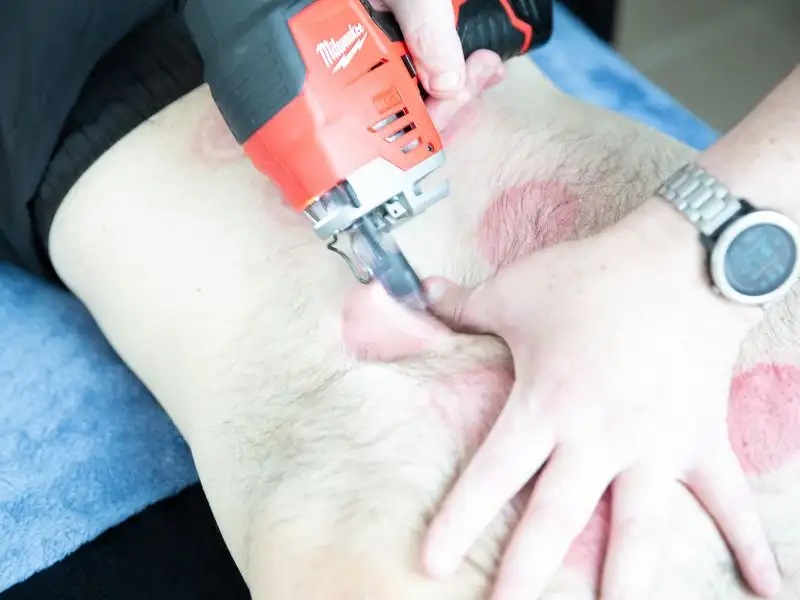
What percussive release is used for
Percussive release is used to help reduce excessive muscle tone and improve how tissue responds to load and movement.
It is commonly applied when muscles feel tight, guarded, or slow to settle with hands-on techniques alone. The vibration input provides a different stimulus to the nervous system, which can help the area relax without forcing pressure.
In clinical use, it is often applied before or between manual techniques to improve access to deeper layers and support smoother movement through a joint.
- Reducing protective muscle tension
- Preparing tissue for manual therapy or movement work
- Supporting short-term changes in tissue compliance
- Assisting areas that fatigue or load quickly
How percussive release works
Percussive release uses rapid, low-amplitude vibration to deliver repeated sensory input into muscle tissue.
This vibration does not stretch or force the muscle. Instead, it influences how the nervous system regulates muscle tone. As the input is processed, sustained contraction can reduce and the tissue may become less guarded.
When tone drops, the area often responds more easily to manual pressure or movement. This is why percussive release is commonly used before or between hands-on techniques rather than as a stand-alone approach.
A 2024 study in the Journal of Sports Science and Medicine (Nakamura et al.) measured the acute effects of percussive massage on plantar flexor muscles and found that it significantly increased range of motion and decreased passive stiffness without reducing muscle strength, supporting its use as a preparation tool before or between manual techniques. (PMID: 38455448)
What percussive release feels like
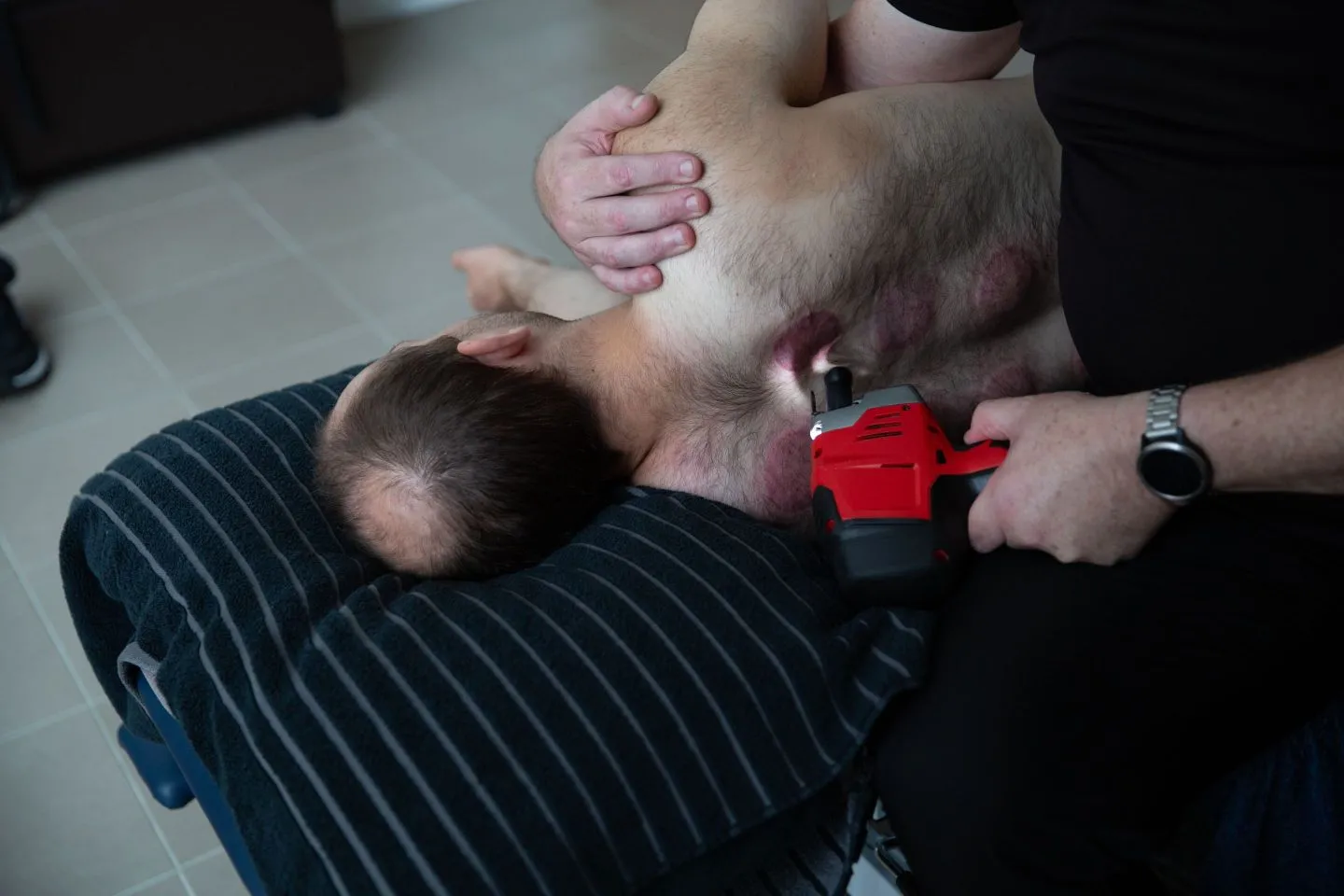
During percussive release, the device delivers a rhythmic vibration through the skin into the muscle. The sensation is usually firm but controlled, and pressure is adjusted based on the area and your tolerance.
Most people describe the feeling as unusual at first rather than uncomfortable. As the muscle settles, the vibration often feels less intense and the area can feel warmer or more responsive.
This technique is typically applied for short periods. It is used to prepare tissue, not to fatigue it, and is commonly followed by hands-on work or movement-based techniques.
Who it may suit / when it may not
Percussive release may suit you if:
- Muscles feel tight, guarded, or slow to relax
- Hands-on pressure alone feels uncomfortable or difficult to tolerate
- You notice stiffness before movement or exercise
- You respond better to gradual input rather than sustained pressure
- You are using manual therapy as part of a broader movement or recovery plan
It may not be appropriate if:
- You feel unwell, feverish, or there are signs of infection
- There is acute inflammation, bruising, or recent tissue trauma
- You have a condition where vibration is not advised
- The sensation feels uncomfortable or overstimulating
- Touch does not feel safe or tolerable at this time
If you’re unsure, that uncertainty is part of the conversation.
Expected outcomes
Responses can differ from person to person.
After a session, some people notice movement feels freer or less resisted through the treated area.
For others, changes tend to show up more gradually over time.
Early shifts are often noticed in how a muscle settles or how a joint moves, rather than an immediate change in pain levels.
Percussive release is not designed as a single-session solution.
Persistent patterns usually respond best to repeated exposure and adjustment across multiple sessions.
How it fits into treatment
Percussive release is usually used as a supporting technique within a session.
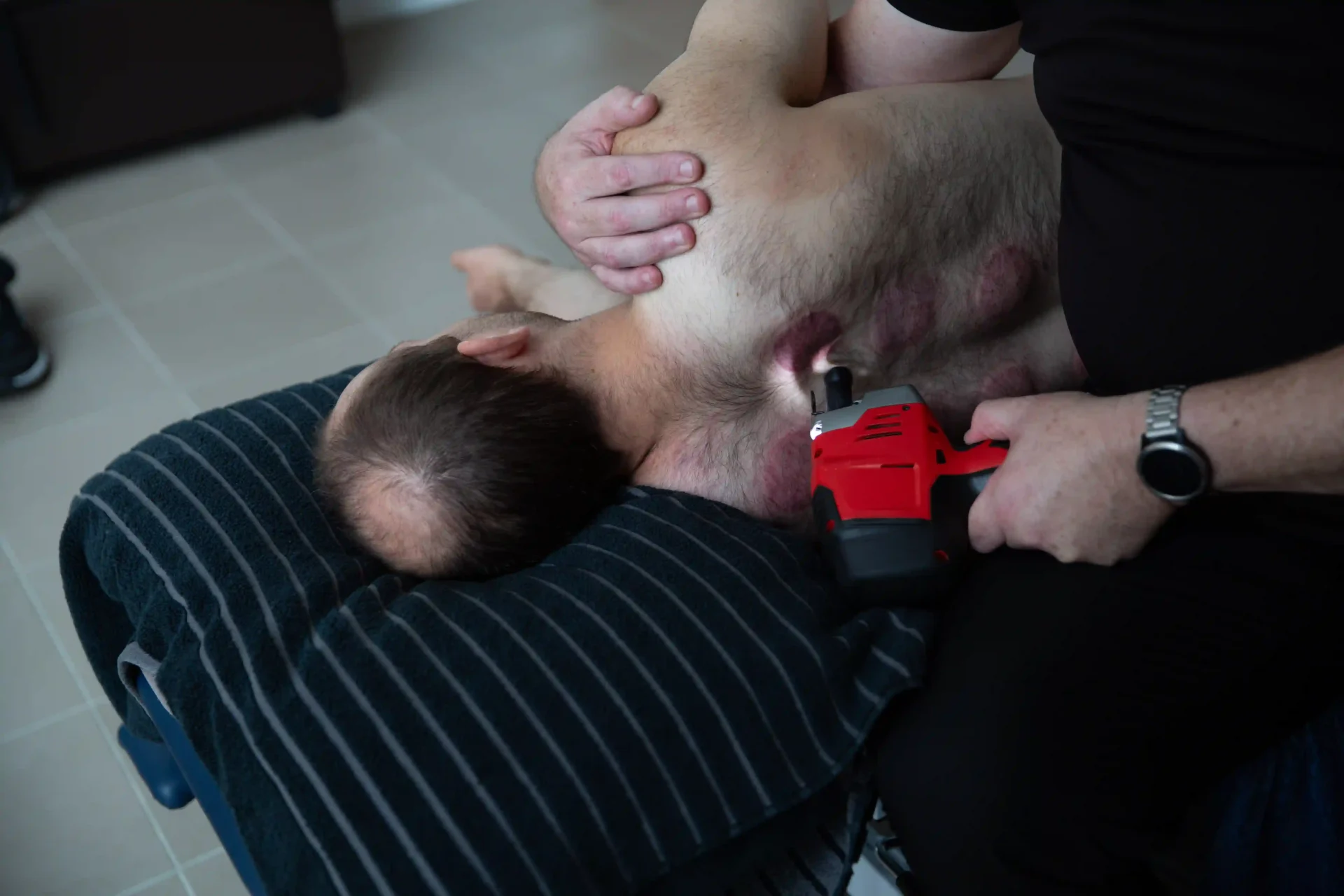
I may use it early to help settle an area that feels guarded, or mid-session to reduce resistance before hands-on work. It can also be used in short bursts between techniques to keep the tissue responsive.
In practice, it often pairs well with movement-based work. The goal is to make movement feel less “stuck” and to help the body hold onto change once you get up and move again.
Last reviewed: June 2026
Next steps
Book online at pcrmt.splose.com/online-booking/0a1e4760-b674-487c-9cd5-b0f2617e15a9
FAQs
Is percussive release the same as using a massage gun at home?
The device may look similar, but the way it is used in a clinical setting is different. At home, most people apply a massage gun to broad areas for general relief. In a session, percussive release is applied to specific areas at calibrated depths and durations based on how the tissue is responding in real time. The decisions about where to apply it, for how long, and at what intensity are guided by assessment rather than general use, which changes what it can achieve.
What does vibration actually do to muscle tissue?
Rapid, low-amplitude vibration delivers repeated sensory input to the muscle and the nervous system. Rather than stretching or compressing the tissue directly, it influences how the nervous system regulates muscle tone. As that input is processed, sustained protective contraction can ease and the tissue becomes more responsive to other techniques. This is why percussive release is often used to prepare an area rather than as a primary treatment, because it makes what follows more effective.
When during a session is percussive release used?
It is most commonly used at the beginning of work on a specific area to help reduce resistance before hands-on techniques are applied, or between techniques when the tissue has tightened back up and needs to settle again. It can also be used at the end of a session to support the transition from treatment to normal movement. The timing is guided by how the tissue is responding rather than a fixed order.
Is it safe to use percussive devices every day?
For general muscle maintenance, daily use of low-intensity percussive devices is not usually harmful. In a clinical context, the frequency and intensity of percussive release are matched to what the tissue can tolerate and what the treatment goal requires. Applying strong percussive input repeatedly to the same area without allowing time for the tissue to respond can work against recovery rather than support it. If you are using a device at home between sessions, lighter and briefer tends to be more appropriate than sustained heavy use.
Which areas of the body respond best to percussive release?
Larger muscle groups, particularly those in the back, glutes, thighs, and calves, tend to respond well to percussive input. These are areas where tissue volume allows the vibration to penetrate effectively. Smaller or more sensitive areas, as well as areas close to bony landmarks, joints, or the spine, require more careful application and are often better addressed through hands-on techniques. Suitability is assessed based on the specific area and how it is presenting on the day.